Total Float vs. Free Float in Critical Path Method (CPM)
When I was preparing for my PMP exam, I was very confused about the difference between Total Float and Free Float in Critical Path Method (CPM). I understood Float, but not the two types. So, I did some research and finally made-up an example to understand the concepts myself. Today I’m sharing the example that I prepared almost 2 years ago. I hope it will help in PMP Certification aspirants on their exam.
What is the difference between Total Float and Free Float?
Total Float is the amount of time that an activity can be delayed from its early start date without delaying the project finish date. Free Float is the amount of time that an activity can be delayed without delaying the early start date of any successor activity.
PMBOK Guide definitions of Total Float and Free Float
Total Float: The total amount of time that a schedule activity may be delayed from its early start date without delaying the project finish date, or violating a schedule constraint. Free Float: The amount of time that a schedule activity can be delayed without delaying the early start date of any immediately following schedule activities.
What is the formula for Total Float?
Total Float = LF - EF (or LS - ES)
where ES = Early Start, EF = Early Finish, LS = Late Start, and LF = Late Finish
What is the formula for Free Float?
Free Float = ES of next activity - EF
Quiz Time - Calculate Total Float and Free Float
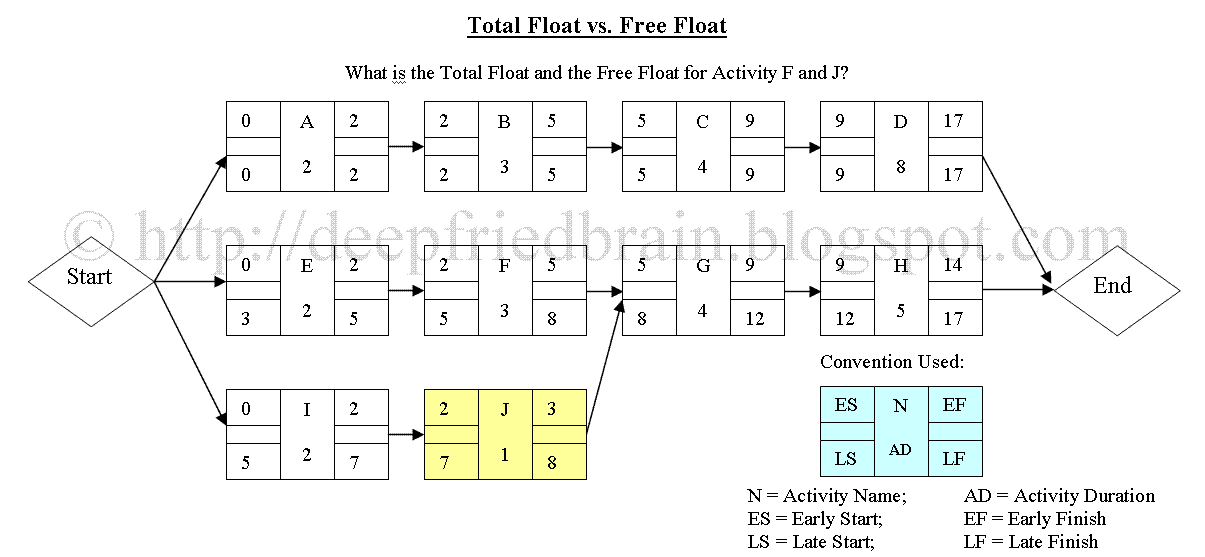
Let’s understand the concepts with the help of an example. Refer to the Network Diagram in the figure first. I’m assuming that you know how to work with a Network Diagram and how to calculate ES, EF, LS, and LF for activities on a Network Diagram. Click on the figure to download the network diagram as a PDF file.
Problem
What is the Total Float and the Free Float for Activity F and J?
Solution
The calculations are really simple.
For Activity F:
Total Float = LF of F – EF of F => 8 – 5 = 3

Free Float = ES of G – EF of F => 5 – 5 = 0
For Activity J:
Total Float = LF of J – EF of J => 8 – 3 = 5

Free Float = ES of G – EF of J => 5 – 3 = 2
Pro Tip
Free float can only occur when two or more activities share a common successor, or in other words, when activities converge on a Network Diagram. In our example, only activities F and J can have Free Float.
In the next section, let’s address the question posted by Dr. PDG in the comments.
Who owns Total Float and who owns Free Float?
Total Float belongs to the project, whereas Free Float belongs to individual activities. If the project is being done under a contract, it’s debatable whether Float belongs to the buyer or seller.
How should the Project Manager use Float on the project?
‘Float’ is a project resource. It should be used judiciously, mainly to cover the risks or other unforeseen issues on the project.
Float is a project resource.
Hope you’ll do well if you get such a question on your exam. If you have any doubts, I’m here to help.
While you are at it, also learn about Negative Float.
Image credit: Flickr / miguelvirkkunen
47 Comments
Dr. PDG
Harwinder Singh
Dr. PDG
Dr. PDG
Nhlosenhle zwane
MS
Anonymous
Harwinder Singh
Chelluri
SOUMIT
williams rodriguez constantino
Harwinder Singh
Rookie
Anonymous
Harwinder Singh
Anonymous
Shraddha
Harwinder Singh
Anonymous
Anonymous
Muhmad
Ram
Anonymous
Anonymous
Parsa Mahmoudzadeh
Amit Ranjan
shameer e.v
Anonymous
Hamid Samadani
Harwinder Singh
Jalal To'ma Nimri
Harwinder Singh
zomuana
Richard
Bikalpa Dhakal
Harwinder Singh
RADHAKRISHNAN MURUGAMANICKAM
Harwinder Singh
Amit
Harwinder Singh
RM
Nelly
Harwinder Singh
Deepak Rajvanshi
Harwinder Singh
ahmed
Pratibha 'KD'